Quick answer
EV charger installation cost on the Northern Beaches depends on four factors: the charger brand (Tesla, Evnex, Zappi), the condition of your switchboard (older boards need upgrading first), the cable run length from switchboard to garage, and whether single- or three-phase is required. A modern switchboard with a short cable run is the most affordable scenario. Connery Electrical provides a free on-site assessment and a fixed-price quote upfront.
Want a price for your place?
Free on-site assessment, then a fixed price before we start.
If you've just bought an EV, or you're thinking about it, the first question is usually the same. How much to get a proper charger installed at home? The honest answer: it depends on a handful of specific factors, all of which we'll walk through below. Bottom line, you'll get a fixed-price quote upfront after a free on-site assessment, so there are no surprises.
The honest version: Every home is different. A modern switchboard with a short cable run to the garage is the cheapest scenario. Older homes that need a switchboard upgrade first, or long cable runs from the meter box to a back garage, naturally cost more. The only way to know for sure is a free on-site assessment.
What You're Actually Paying For
An EV charger install has three cost buckets. The charger itself, the labour and materials to get it on the wall, and any upgrades your home needs to safely run a 32-amp dedicated circuit. Skip any of these and you're either getting a dodgy install or a very fast quote on a job that shouldn't happen.
1. The charger unit
Entry-level chargers are the most affordable basic units. Mid-range options like the Tesla Wall Connector and Evnex sit in the middle. Premium units like the Zappi (which diverts excess solar energy to your car) or three-phase chargers like the Evnex X22 are at the top end. The right charger for you depends on your vehicle, whether you have solar, and what features you'll actually use.
2. The installation labour
A straightforward installation where your switchboard is modern and the charger mounts close to the meter box is the cheapest scenario. If your charger is going on the opposite side of the house, or you're in an apartment with cable running through common areas, labour and cable run cost more.
3. The electrical work your home actually needs
This is where quotes vary the most. A home with a modern switchboard, spare capacity, and short cable runs needs nothing extra. An older home with ceramic fuses, no spare circuit breakers, or wiring that's seen better days might need a switchboard upgrade before the charger can safely go in. This is the single biggest cost variable across Northern Beaches homes.
The Six Install Types We See on the Northern Beaches
Across Manly, Dee Why, Brookvale, Mona Vale, Frenchs Forest and surrounding suburbs, EV charger installs fall into roughly six categories. The category your home fits into is the biggest driver of cost.
| Install type | Cost tier | Who it suits |
|---|---|---|
| Entry single-phase (7kW) | Most affordable | Modern switchboard, short cable run, basic charger |
| Mid-range single-phase (7kW) | Standard | Tesla Wall Connector or Evnex, standard house |
| Solar-diverter install (Zappi) | Standard plus | Homes with solar wanting to charge from excess |
| With switchboard upgrade | Higher | Older homes, often pre-1990s builds |
| Three-phase (11kW or 22kW) | Higher | Homes with three-phase power, faster charging |
| Apartment / strata install | Variable | Includes strata liaison, long cable runs, metering |
The honest reality: a quote that seems suspiciously cheap usually means corners are being cut. Watch for missing switchboard assessments, no Certificate of Compliance, or cable runs that don't follow AS/NZS 3000. Connery Electrical quotes itemised so you can see exactly what's included.
Tesla, BYD and Other Car-Brand Installs on the Northern Beaches
One of the most common questions we get is whether a particular car needs a particular charger. The short version: almost every EV sold in Australia uses the same Type 2 plug, so a good-quality 7kW home charger will charge a Tesla, BYD, Kia, Hyundai, MG, Polestar or Volvo without any trouble. The charger is matched to your home and your switchboard, not the badge on the car.
Tesla Wall Connector installs
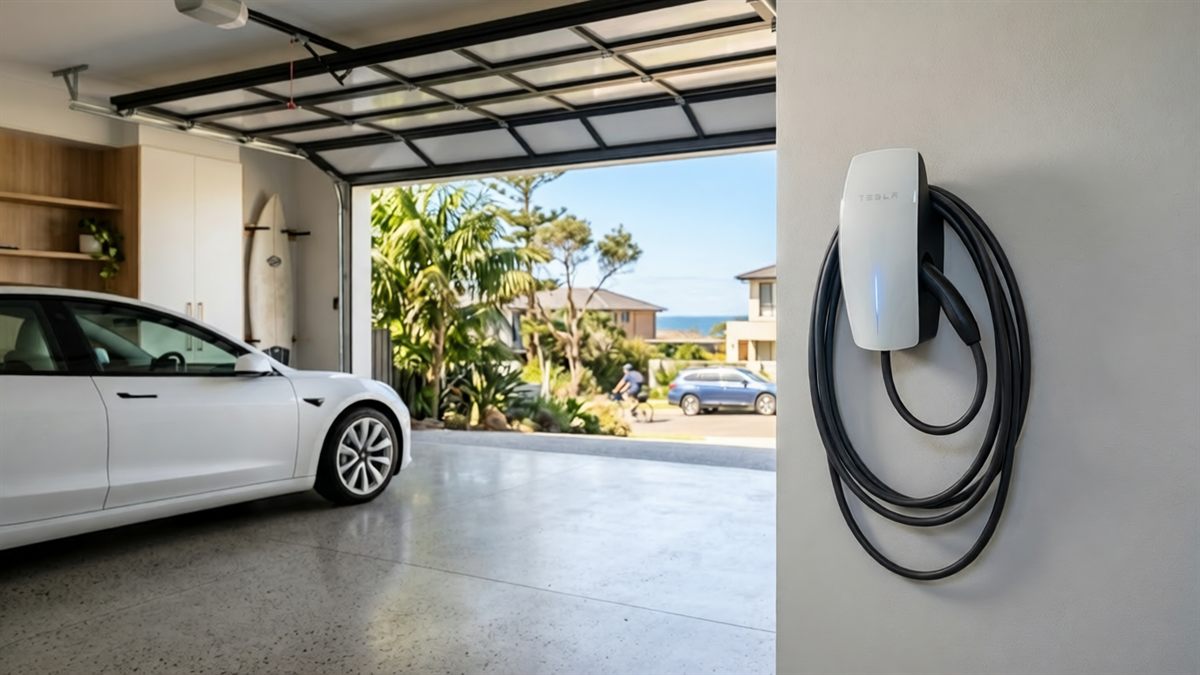
If you drive a Tesla, you've got two solid options. The Tesla Wall Connector is a clean, fast 7kW unit that pairs neatly with the Model 3, Model Y, Model S and Model X, and it's one of the most common chargers we install across the Northern Beaches. Or you can run any other quality Type 2 charger and keep the mobile connector that came with the car as a backup. We handle Tesla Wall Connector installs regularly in Manly, Dee Why, Mona Vale and surrounds, and the cost works out the same as any other quality 7kW unit. It comes down to your switchboard and the cable run, not the Tesla badge.
BYD, Kia, Hyundai and the rest
BYD, the Kia EV6 and Niro, Hyundai Ioniq and Kona, MG, GWM, Polestar and Volvo all charge happily on a standard Type 2 home charger. If you're not sure which charger suits your car and your driving, we've written a plain-English guide on which EV charger to pick for your car. Whatever you drive, the residential EV charger installation cost on the Northern Beaches comes down to the same three things: the charger you choose, your switchboard, and the cable run from the meter box.
Seven Things That Push Your Quote Up (or Down)
Every home is different, which is why the range is so wide. These are the factors that move your quote, in rough order of impact.
- Switchboard condition. If your board has ceramic fuses, no spare breakers, or is not RCD-protected, it likely needs an upgrade before a 32-amp EV circuit can go in safely. This is the single biggest cost variable.
- Cable run distance. Short runs from the switchboard to the charger are cheap. Long runs through walls, ceilings, or under a slab cost more in cable, labour, and time.
- Charger brand and features. A basic 7kW unit costs less than a smart charger with app control or solar diversion. Decide what you actually need before you pay for features you won't use.
- Mounting location. A charger on an exposed external wall near the switchboard is the cheapest option. Chargers in detached garages or second storeys add labour and cable.
- Single-phase vs three-phase. Single-phase 7kW chargers are fine for most homes. Three-phase installs cost more and only pay off if your home has three-phase supply and your car can use the faster rate.
- Strata and apartments. Apartment installs involve body corporate approvals, metering decisions, and longer cable runs through common areas. This adds materially to a quote versus a standalone house.
- Access and parking. Tight driveways, difficult wall access, and jobs that need extra safety gear or scaffolding push labour up.
What a Fair Quote Should Include
A proper EV charger quote is itemised, not a single lump sum. When you're comparing quotes on the Northern Beaches, look for these items broken out:
- The charger model, brand, and warranty
- Switchboard assessment (and whether an upgrade is needed or not)
- Dedicated circuit and RCBO breaker
- Cable type and run length
- Mounting, commissioning, and testing
- Certificate of Compliance (legally required in NSW)
- Any strata or council documentation if relevant
- Warranty on the installation work
Red flag: If a quote is missing a switchboard assessment or Certificate of Compliance, that's a problem. Both are essential for a safe, legal install, and both are things a licensed NSW electrician includes as standard.
Ways to Bring the Cost Down
A safe, compliant install is non-negotiable, so cutting corners on materials or skipping the Certificate of Compliance is never the right move. But there are sensible ways to keep costs reasonable.
- Mount the charger near the switchboard. Every metre of cable adds cost. If the garage is on the other side of the house, ask if an exterior-mounted charger closer to the meter box works just as well.
- Pick the charger you need, not the flashiest one. For most daily commutes, a good-quality 7kW unit charges overnight with room to spare. Solar diversion is worth it if you have 6kW+ of solar. Otherwise it's a feature you pay for but rarely use.
- Do the switchboard upgrade at the same time. If your board needs work anyway, bundling it with the EV install saves a second call-out and a second day of labour.
- Get two or three quotes. Not to haggle, but to spot the one that skipped the switchboard check or didn't mention the Certificate of Compliance. Those are not the cheap ones, they're the risky ones.
Why Northern Beaches Installs Can Differ
A lot of Northern Beaches homes were built between the 1960s and 1990s, and many still have the original switchboards. Add salt air corrosion on external wiring, and older fuse boards that were never sized for a modern home's load, and you get a higher rate of switchboard upgrades required before an EV install can happen.
It's not universal. Newer builds in places like Warriewood Valley, or fully renovated homes in Avalon and Curl Curl, often have modern boards and spare capacity. But if your home is original, factor in a switchboard assessment as part of the quote.
If you want the rundown on when a switchboard actually needs upgrading (and when it doesn't), see our guide on 7 signs your switchboard needs upgrading. Or if you want to check whether your specific board can handle an EV charger, see our switchboard and EV charger guide.
What the Install Actually Looks Like
From the homeowner's side, a straightforward job takes one visit. Here's what happens:
- Free on-site assessment. We check the switchboard, measure the cable run, confirm the charger location, and write up a fixed-price quote.
- Book the install. Single-phase jobs take 2 to 4 hours, three-phase or switchboard-upgrade combos take a full day.
- Cable run installed from the switchboard to the charger location, dedicated breaker added, charger mounted and wired in.
- Commissioning and testing, Certificate of Compliance issued, and a quick walkthrough on how to use the charger.
- You plug your car in that afternoon.
The Bottom Line
For most Northern Beaches homes, the install cost depends on three things: the charger you choose, the condition of your switchboard, and the cable run from the meter box. A detailed, itemised quote from a licensed electrician is the only way to know for sure, and any good sparky will do the assessment for free.
Want a no-obligation quote on your home? Connery Electrical does EV charger installs across the Northern Beaches every week. See our EV charger installation service or call 0421 755 198.