Quick answer
Your Northern Beaches switchboard likely needs upgrading if you see any of these: ceramic fuses, no safety switches (RCDs), repeatedly tripping circuits, warm or burnt-looking enclosure, salt-air corrosion on the box, or no capacity for new circuits like an EV charger or solar. Anything wired before 1990 is also a strong candidate. A licensed electrician can confirm in a free 15-minute on-site assessment.
Your switchboard is the most important piece of kit in your house, and it's the one most people never think about. Until something trips at midnight, or the insurance company asks awkward questions after a fire. This guide covers the seven warning signs every Northern Beaches homeowner should know, plus the stuff that's specific to coastal homes.
Quick check: Walk out to your switchboard. If you see ceramic fuses, no RCD (safety switch) buttons, or a board that hasn't been touched since the last century, you almost certainly need an upgrade. Read on for the rest of the signs, and what to do about it.
What a Switchboard Actually Does
Your switchboard takes mains power from the street and splits it into separate circuits for lights, powerpoints, the oven, the hot water, the air-con, and everything else. Each circuit has a breaker (or in older homes, a fuse) that's meant to cut power the instant something goes wrong. Shorts, overloads, earth faults, the lot.
A modern switchboard also has RCDs, which are the lifesavers. An RCD detects when current is leaking out of a circuit (for example, through a person who's just touched a live wire) and cuts power in about 30 milliseconds. Older boards don't have these, and that's where most of the real risk sits.
The 7 Warning Signs
You Still Have Ceramic Fuses
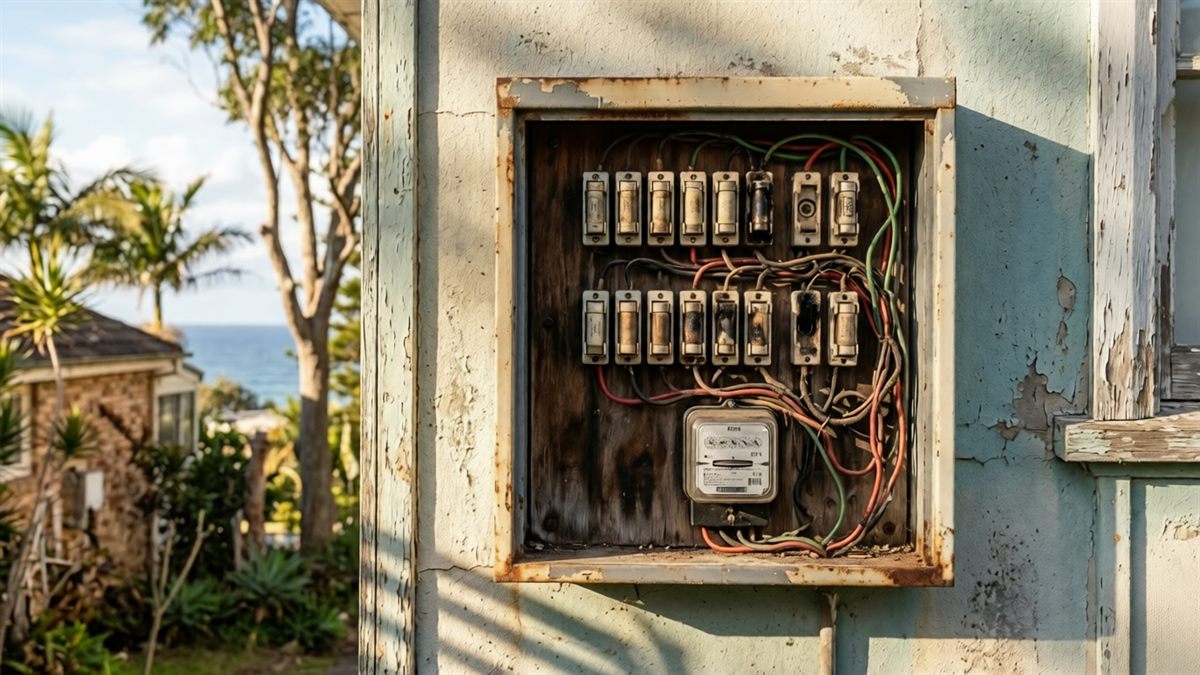
If your switchboard has little white porcelain cylinders with wire inside them, that's ceramic fuse wire, and it's decades out of date. Ceramic fuses were standard in Australian homes before the 1990s. They work, in the sense that they blow when there's a short, but they don't protect against the things modern breakers and RCDs do. Replacing a blown ceramic fuse involves rewrapping the element by hand, which most people either do wrong or skip altogether.
Verdict: Upgrade now. This is the clearest sign.No RCDs (Safety Switches)
RCDs are the test-button breakers that cut power in milliseconds if electricity is leaking somewhere it shouldn't. Under AS/NZS 3000:2018, every new circuit in an Australian home has to have RCD protection. Plenty of older Northern Beaches homes still have zero RCDs on the board, which means if someone touches a live wire or a faulty appliance, there's nothing stopping the current going through them.
Look for buttons marked "Test" or "T" on your breakers. No buttons means no RCDs.
Verdict: Upgrade or retrofit RCDs, urgently.Breakers Trip Regularly, or Won't Reset
One trip every blue moon is normal. Breakers tripping every few weeks, or a breaker that won't stay on when you reset it, is not. It usually means one of three things. A circuit is overloaded because modern appliances are drawing more than the board was sized for. A breaker is worn out and tripping at lower loads than it should. Or there's a fault on the circuit itself that needs finding before anything else.
Repeatedly resetting a tripping breaker is a fire risk. That's the breaker doing its job, and jamming the switch back up is fighting against it.
Verdict: Get it checked. Might just be one faulty breaker, might be the whole board.Buzzing, Crackling, or a Burnt Smell
Switchboards should be quiet. A faint hum from the meter is fine. A buzzing, crackling, or sizzling sound coming from inside the box is not. Same for any smell of burnt plastic, hot metal, or anything remotely smoky near the board. That's an electrical emergency — switch off the power at the main switch and call a sparky straight away.
These are signs of arcing, loose connections, or heat damage inside the board, any of which can turn into a fire. This is the one warning sign that warrants a phone call the same day, not next week.
Verdict: Stop using the board. Call a licensed electrician today.Flickering or Dimming Lights
Lights that flicker when you turn on the kettle, the air-con kicks in, or the washing machine starts, are telling you the circuit can't handle the load cleanly. Sometimes this is a worn breaker, sometimes it's a loose connection on the board, and sometimes it's the whole house asking for more capacity than the board was ever meant to supply.
Single-lamp flicker is usually just a dodgy bulb. But whole-room or whole-house flicker, especially when big appliances turn on, is a board issue until proven otherwise.
Verdict: Diagnostic visit. Often pairs with item 6 below.You're Maxing Out the Board
A lot of Northern Beaches homes were wired in the 70s and 80s for maybe 40 or 60 amps of total load. Lights, a fridge, a TV, an oven, a kettle, job done. Fast forward to 2026 and the same house has air-con in every room, an induction cooktop, a heat-pump hot water system, two EVs, solar, a home office, and a pool pump.
If you've added new appliances lately (especially anything with a motor or a heating element), and you notice new issues like breakers tripping or the lights going funny, the board is probably telling you it's run out of road.
Verdict: Upgrade, often combined with an EV charger install or solar install.You're Planning an EV, Solar, or Heat Pump Install
This is the proactive one. EV chargers, solar inverters, and heat-pump hot water systems all need a dedicated circuit, and usually a dedicated RCBO breaker. If your board is full (no spare slots) or older than about 25 years, the installer's first job is going to be a switchboard upgrade before anything else can happen.
A lot of people only find out when the solar or EV quote comes back with an extra line item for switchboard work. Worth checking the board before you book anything, so you know what you're walking into. If you're looking at an EV charger specifically, see our guide on whether your switchboard can handle an EV charger.
Verdict: Get an assessment before the other install is quoted.Coastal Homes: The Northern Beaches Factor
Salt air does two things that inland homes don't deal with. It corrodes metal, and it gets into places that should be sealed. External meter panels, cable glands on the outside of homes, and older switchgear closer to the coast all wear out faster than their inland equivalents.
If your home is within a few hundred metres of the beach (think Manly, Curl Curl, North Curl Curl, Collaroy, Narrabeen, Newport, or Avalon Beach), it's worth having the board and meter panel inspected every 5 to 10 years even if everything seems fine. We've opened boards in Collaroy with rust flaking off the back of the enclosure, and connections green with corrosion, while the house still appeared to work normally.
The other Northern Beaches-specific factor is age. A lot of original beach houses in Freshwater, Queenscliff, and Manly Vale are 50+ years old and still have much of their original wiring. These homes often need more than just a board swap, they need a full rewire sooner or later. An inspection sorts out whether you're looking at a straightforward upgrade, or something bigger.
What an Upgrade Actually Involves
A switchboard upgrade on the Northern Beaches is usually a one-day job for an experienced sparky. Here's what happens:
- Power off for the duration. Most upgrades take 4 to 8 hours, so you're without power for a working day.
- The existing board is removed, and the enclosure is checked (and replaced if needed).
- A new board is mounted with clearly labelled RCBO breakers for each circuit, meeting current AS/NZS 3000:2018 standards.
- All existing circuits are terminated into the new board, tested, and commissioned.
- A Certificate of Compliance (CoC) is issued, and you get a walkthrough of the new board.
The cost of a residential upgrade depends on the size of the board, how many circuits, and whether any rewiring is needed on the meter panel. Commercial and three-phase upgrades are quoted separately. Connery Electrical gives you a fixed price upfront after a free on-site assessment, so you know what you're walking into before any work starts.
Doing an EV charger install too? Bundle the switchboard upgrade with the EV install in one visit. You save on a second call-out and a second day of labour, and the charger goes straight in once the board's done. See the EV charger cost guide for how those two jobs fit together.
What to Do Next
If you spotted one sign on this list, get the board inspected when convenient. If you spotted two or more, book the inspection now, especially if any of them involve heat, smell, or repeated tripping. An inspection itself is a short visit (under an hour), and the electrician can tell you whether you're fine, need a minor retrofit, or should budget for a full upgrade.
Connery Electrical does switchboard upgrades across the Northern Beaches every week. See our switchboard upgrade service, or call 0421 755 198 for a free on-site assessment.