Quick answer
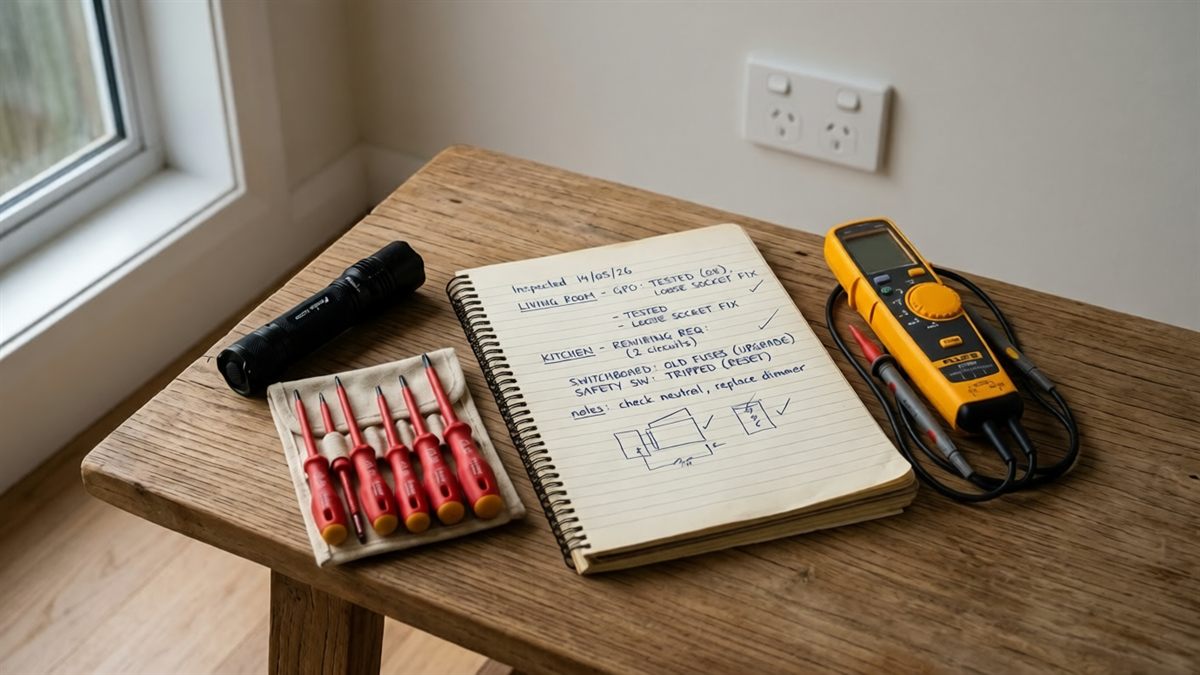
A residential electrical safety inspection on the Northern Beaches takes 90 minutes to 2 hours and covers the switchboard, every powerpoint, light switches and fittings, smoke alarms, outdoor and pool electrical, and any visible fixed wiring. Every safety switch is tested. You receive a written report within 24 hours. Standard guidance: every 5–10 years for owner-occupied homes, every 2 years for rentals, and immediately for pre-1990 homes.
Most Northern Beaches homeowners only think about an electrical safety inspection when something goes wrong, when they're buying or selling, or when the strata bill turns up. By that stage you're often paying to fix a fault that an inspection would've spotted years ago for a fraction of the cost. This guide covers when to book one, what gets checked, what it costs in 2026, and what local sparkies most often find when they open the cover.
Quick check: if your home is over 25 years old, has ceramic fuses, or hasn't been inspected since you bought it, you're overdue. The rest of the article tells you what to expect when the sparky shows up.
What an Inspection Actually Is
An electrical safety inspection is a structured walk-through of every part of your property's electrical system, performed by a licensed electrician. It's not just a glance at the switchboard. A proper inspection covers the meter panel, switchboard, every powerpoint and light fitting, the hot water and oven circuits, smoke alarms, outdoor and pool electrical, and the visible parts of the fixed wiring.
The output is a written report that tells you what's safe, what's borderline, and what needs fixing. For straightforward homes that's a one-page summary. For older homes or ones that have had patchy DIY work over the years, it can run several pages with photos and recommendations.
The point of the inspection is to catch the stuff that hasn't caused a problem yet but will, before it does. It's the same logic as a pre-purchase building report or a car service.
When You Should Book One
Seven situations where an inspection is worth doing. Most homeowners hit at least one of them.
You're Buying a Home
A pre-purchase electrical inspection is one of the cheaper insurance policies you can buy. For a small upfront cost, you find out whether the property has compliant safety switches, whether the wiring is sound, and whether the switchboard is going to need replacing in five years (which can be a serious surprise after settlement).
Ask the seller's agent if there's a recent inspection report available. If not, get one before you go unconditional. Find a fault during cooling-off, and it's leverage to renegotiate the price.
Verdict: Always worth it. Bake into your pre-purchase due diligence.You're Selling or Renting Out the Property
For sellers, a clean inspection report is a useful add to the property listing, especially for older homes where buyers will assume the electrical is dated. For landlords, regular inspections are part of your duty of care under NSW residential tenancies law, and they help avoid bigger maintenance bills mid-tenancy.
Smoke alarms in rental properties have to comply with NSW legislation. An inspection confirms they're correctly placed, working, and within their 10-year service life.
Verdict: Required for landlords. Smart for sellers.You're Renovating or Extending
Any new electrical work has to comply with AS/NZS 3000:2018. If you're adding rooms, knocking out walls, or changing the layout, the new work usually has to integrate with existing wiring that may not meet current standards. An inspection before the renovation tells you whether you're walking into a partial-rewire situation, or whether the new work can tap in cleanly.
Same goes for kitchen or bathroom renos, which often need new circuits, RCDs, and updated wiring before the new fittings can legally be installed.
Verdict: Book before any quoting. Saves rework on the build.The House Is Over 25 Years Old and Hasn't Been Checked
Australian wiring standards have changed multiple times since the 1990s. Houses wired in the 70s and 80s often don't have RCDs, may have ceramic fuses, may be running on undersized cables for modern loads, and may have aluminium-jointed connections that loosen over time.
Most of these aren't immediate dangers, but they're tomorrow's problem if you don't get ahead of them. Inspections at this stage usually flag two or three things to fix and a board upgrade somewhere on the horizon.
Verdict: Book one even if everything seems fine.After a Storm or Near-Miss
Southerly busters, hailstorms, and the occasional flash flood across the Northern Beaches all push damage into the electrical system, even when nothing visibly fails. Power surges can fry inverter boards, transformers in fixed appliances, and sometimes the breakers themselves. An inspection after a serious weather event picks up the silent damage before it becomes a fault.
Same applies after a near-miss, like a breaker tripping with a buzz, or a powerpoint that suddenly went hot to the touch. The fault may have stopped, but the cause is still there. If it's still happening, that's when to call an emergency electrician.
Verdict: Within a week of the event.Your Insurance Company Asks for a Compliance Certificate
Some insurers ask for a current compliance certificate after a claim, particularly for fire-related claims or for older homes. A safety inspection generates this, plus the supporting paperwork the insurer needs.
If you're shopping insurance for an older home, having a recent inspection report on file can also help with cover and premiums.
Verdict: When the insurer asks. Don't delay.You're Installing an EV Charger, Solar, or Heat Pump
Big new loads need RCBO protection, sufficient board capacity, and properly sized cabling. An inspection before the installer quotes is the cleanest way to know whether the existing setup can handle the new gear, or whether a switchboard upgrade or partial rewire needs to come first.
This pairs especially well on the Northern Beaches with EV charger installs, where most of the homes considering one are in the 30+ year bracket. See our EV charger cost guide for how this fits together.
Verdict: Before the EV/solar quote. Saves rework.What Gets Checked
A full residential safety inspection takes 90 minutes to two hours and covers the following.
Switchboard & Meter Panel
- Panel condition, sealing, and weatherproofing
- Main switch and breaker condition
- RCD (safety switch) presence, function, and trip-test timing
- Earth connection and earth-stake bond
- Circuit labelling and clarity
- Signs of arcing, heat damage, corrosion, or pest entry
Powerpoints, Light Switches & Fittings
- Polarity and earth continuity at every accessible outlet
- Visible damage, cracks, scorching, or wobble
- RCD coverage on each circuit
- Bathroom and kitchen-zone compliance (dampness rated)
- Outdoor outlets weatherproofing and cover seals
Smoke Alarms
- Number and placement against AS 3786 and NSW legislation
- Type (photoelectric required for new installs since 2017)
- Battery and unit expiry (max 10-year service life)
- Test-button function
- Hard-wired alarm interconnection where applicable
Fixed Appliances & Major Circuits
- Hot water system circuit and isolation
- Oven, cooktop, and rangehood circuits
- Air-con and ducted heating circuits
- Pool, spa, and outdoor electrical sub-circuits
- Pump-house and granny-flat sub-mains where present
What Local Sparkies Find Most Often
Patterns repeat across the Northern Beaches. After enough years on the tools, you start to see the same five or six findings come up across most older homes.
Manly, Curl Curl & Freshwater
The oldest housing stock on the Beaches. Most common finding is missing or insufficient RCDs, especially on bathroom and kitchen circuits. Many original beach homes still have ceramic fuses in part of the board. Expect at least one circuit needing a retrofit RCBO.
Mona Vale, Newport & Avalon
Salt-air corrosion on external meter panels and outdoor fittings. The classic finding here is rust through the back of an external switchboard enclosure, or green corrosion on connections inside. Outdoor RCD outlets are often non-compliant on older installs.
Brookvale, Dee Why & Cromer
Heavy mix of older flats and walk-up apartments. Common findings are unlabelled circuits in shared switchboards, ageing rubber-insulated cables in ceiling spaces, and DIY work in renovated units that hasn't been certified. Strata buildings often get partial inspections, missing common-area faults.
Beacon Hill, Frenchs Forest & Belrose
Bushfire-zone homes need extra attention to outdoor wiring, garden lighting, and pump circuits. Common finding is undersized cabling on garden lighting and pool pump runs. Sub-mains to sheds and granny flats often lack proper RCD protection.
Collaroy, Narrabeen & Warriewood
Flood-prone in big rains. The recurring finding is water damage to powerpoints near floor level on the lower side of homes near Narrabeen Lake or the coast strip. Pool electrics often non-compliant on older installs, especially around lighting and pumps.
Balgowlah, Seaforth & Fairlight
Mid-century housing with patchy renovation history. Common finding is one section of the home on modern protection while another section is on original 60s-era wiring with no RCDs. Mixed-era boards are typical and usually warrant a single full upgrade.
What Affects the Cost
Safety inspection cost on the Northern Beaches scales with a few specific factors. Here's what moves the price.
| Property Type | Cost Driver |
|---|---|
| Standard 3-4 bed home | Baseline. Switchboard plus 8 to 12 circuits. |
| Pre-purchase inspection | Adds time for a written report you can use during settlement. |
| Larger home or dual-occupancy | More circuits, more rooms, more time on the inspection. |
| Older home (pre-1990) | Aged wiring needs more careful inspection. Often a longer visit. |
| Commercial premises | Quoted separately based on circuit count and three-phase complexity. |
| Strata common areas | Scales with the size of the common-area electrical scope. |
The inspection itself is fixed-price, agreed before booking after a free chat about the scope. Anything found that needs fixing is quoted separately, and you're free to get other quotes before agreeing. There's no obligation to use the inspector for the follow-up work, though most people do because the inspector already knows the property.
What Comes After the Inspection
You get a written report listing every finding. Each item is graded:
- Compliant. No action needed.
- Recommended. Not a fault, but worth fixing soon (e.g. an unlabelled circuit, a worn outlet still working).
- Non-compliant. Doesn't meet current standards, should be fixed (e.g. missing RCDs on a bathroom circuit).
- Urgent. Active safety risk, fix immediately (e.g. exposed wiring, signs of arcing).
The report includes a quote for any recommended or non-compliant work. For straightforward findings, you can usually book the follow-up work in the same visit and avoid a second callout. For bigger work like a switchboard upgrade or partial rewire, it's a separate booking with proper planning.
Bundling tip: if the inspection flags a switchboard upgrade plus an EV charger or solar install, do them in one visit. Saves a callout and a day of labour. See switchboard warning signs for what counts as needing replacement.
Booking on the Northern Beaches
Connery Electrical does residential safety inspections across the Beaches, from Manly through to Palm Beach plus inland to Frenchs Forest, Beacon Hill, and Belrose. Inspections book a few days out, and we leave you with a clear written report you can use for insurance, sale, or just peace of mind.
For more on what gets fixed once an inspection flags something, see the safety inspection service page or call 0421 755 198 for a fixed-price quote.