Quick answer
A safety switch (RCD) that keeps tripping is responding to a real electrical fault, even if it's intermittent. The five most common causes are a faulty appliance (the single biggest one), moisture in an outdoor circuit, damaged wiring or a powerpoint, an overloaded circuit, or the safety switch itself failing. A 10-minute appliance test isolates the cause in roughly 60% of Northern Beaches homes.
If you've found this page, you're probably standing next to your switchboard with the lights out, wondering whether to flick the switch back on for the fourth time tonight. Don't. Read this first. We'll walk you through the five things it's most likely to be, the ten-minute test that finds the culprit in most homes, and the point at which you stop and ring a sparky.
Stop and read this first. A safety switch that keeps tripping is doing its job, not failing at it. It's detecting electricity leaking somewhere it shouldn't, and that "somewhere" is sometimes a person. If the switch refuses to reset at all, or you smell burning, or you feel even a faint tingle from any appliance, light fitting, or metal tap, don't keep testing. Ring an electrician same day.
What a Safety Switch Actually Does
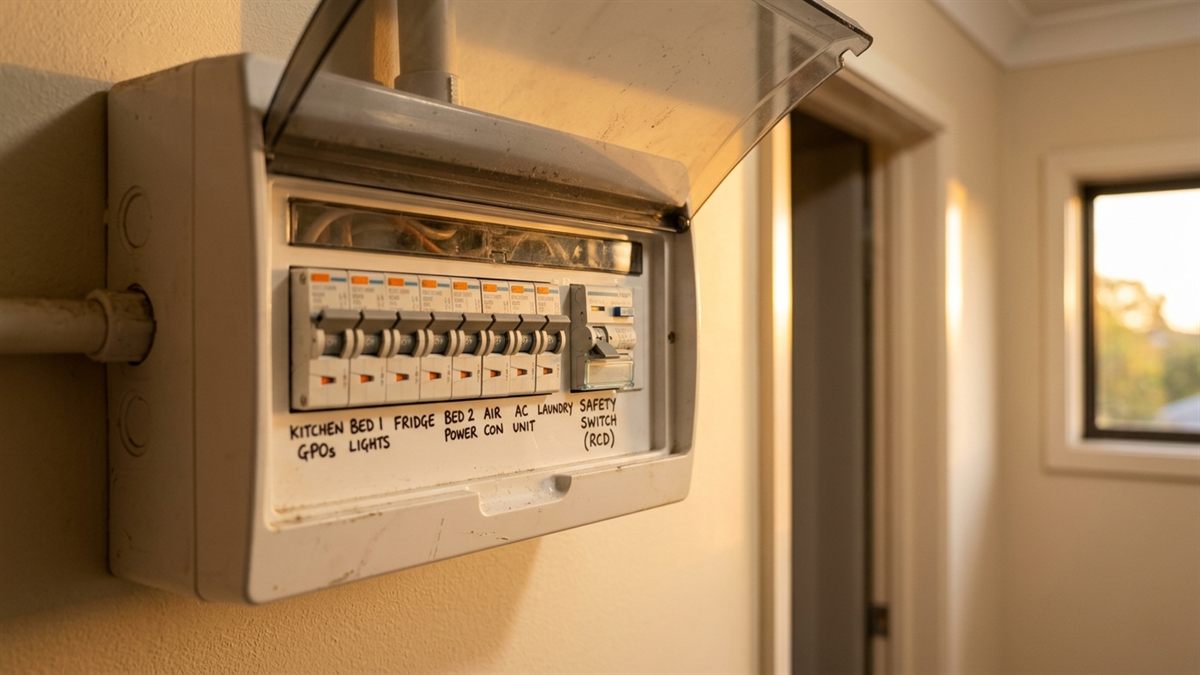
A safety switch (the proper name is a Residual Current Device, or RCD) constantly compares the electricity going out of a circuit with the electricity coming back. If those numbers don't match, even by 30 milliamps, it cuts the power in about 30 milliseconds. That's faster than your heart can be stopped by a shock.
So when it trips, it's because current is leaving the circuit through something it shouldn't, like damp insulation, a damaged cable, a faulty heating element, or in the worst case, a person who's just touched a live conductor. The switch doesn't know what the leak is, only that one's there. Finding the cause is the whole job.
Here's the part that catches people out. A safety switch can trip and then reset just fine for hours, days, or weeks before tripping again. That doesn't mean the fault has gone away. It means the leak isn't constant. The fault is still in your home, and it will be back. Usually at 2am, or right before guests arrive.
The 5 Most Common Causes (Ranked)
In a typical Northern Beaches home, around 80% of tripping safety switches come down to one of these five issues. They're ordered from most to least common based on what we actually find on callouts.
A Faulty Appliance
By a long way, the most common cause. Appliances with heating elements (kettles, irons, toasters, dryers, dishwashers, ovens) and motors (washing machines, fridges, pool pumps, pumps in spas) deteriorate over time. Internal insulation breaks down, water gets where it shouldn't, and a small amount of current starts leaking to earth.
The appliance may still appear to work normally. It's the leak the safety switch sees, not the appliance failing outright. Pool pumps and washing machines on the Northern Beaches are particularly notorious, partly because of age, partly because they live in damp spots.
Verdict: Run the appliance test below. Often a free fix (unplug the dead one).Moisture in the Circuit
Water and electricity are the classic mismatch. If rain has gotten into an outdoor power point, a light fitting in a bathroom, a garden socket, or the wiring inside a wall after a leak, that moisture creates a path to earth and the switch sees it as a leak.
The Northern Beaches gets a particular flavour of this. Salt air, damp coastal mornings, and the occasional southerly buster mean outdoor circuits and external power points wear faster than inland. We see plenty of tripping circuits in Curl Curl, Collaroy, Avalon and Manly where the actual cause is one outdoor socket that's been quietly filling with moisture for a year.
If the trips correlate with rain, sprinklers, or a recent bathroom job, this is probably your answer.
Verdict: Visually inspect outdoor sockets, then call a sparky if anything looks wet or rusted.Damaged Wiring, Power Points, or Light Fittings
Wires get nicked during reno work, mice chew insulation in roof spaces (more common than people think), and old power points develop loose connections that arc inside the wall. Any of these can create a leak that trips the safety switch.
This is usually the cause if the switch trips with everything unplugged, or trips immediately when you reset it without using anything. The fault is in the fixed wiring, and finding it needs insulation resistance testing and circuit isolation, which is a sparky's job.
Verdict: Diagnostic visit. Often resolved in one visit with the right tools.An Overloaded Circuit
This is less common as a cause of safety-switch tripping specifically (overloads usually trip the regular circuit breaker, not the RCD), but a combined RCBO breaker handles both jobs and can be tripped by either. Modern households on circuits sized for 1985 are a common reason. Air-con plus oven plus dishwasher plus EV charger on the same circuit is a recipe.
If trips correlate with specific high-draw appliances all running at once, this is likely the cause.
Verdict: Often resolved with a circuit redistribution, sometimes needs a switchboard upgrade.The Safety Switch Itself Has Failed
Last on the list because it's the rarest, but it does happen. Safety switches have moving parts and contacts that wear out. An older RCD that's been tripping reliably for years can start nuisance-tripping with no real fault behind it, or fail to trip when it should.
A licensed electrician can test the safety switch with a meter to confirm it's tripping at the right current, in the right time. If it's faulty, the swap is a quick job. Don't replace it yourself, it's metered, sealed work.
Verdict: Get it tested. RCBO swap is a short, straightforward job.The 10-Minute Appliance Test
Before you ring anyone, run this test. About 60% of tripping safety switches are solved without an electrician needing to come out. The catch is doing it methodically. Skip a step and you'll just confuse yourself.
- Identify the tripped circuit. Open your switchboard. The breaker that's flipped down (or in the middle position) is the affected one. If a master safety switch covers the whole house, all the lights and powerpoints will be off.
- Unplug everything on that circuit. If you're not sure which appliances are on which circuit, unplug everything except the fridge and freezer (you'll add them back last). Walk through the rooms that are dark and pull every plug.
- Reset the safety switch. Flick it back up. If it stays on, the fault is in an appliance, and you'll find it in the next steps. If it trips again immediately with nothing plugged in, the fault is in the fixed wiring. Stop here and call a sparky. If it won't reset at all, that's one of the signs it's time to call an emergency electrician.
- Plug appliances back in, one at a time. Wait at least 60 seconds between each one. Use the appliance briefly if it's something like a kettle or washing machine, not just plugged in but actually drawing power.
- Note which appliance trips the switch. When the safety switch trips again, the last appliance you plugged in is the culprit. Don't use it. Unplug it, reset the switch, and continue testing the rest to make sure there's only one fault.
- Replace or repair the faulty appliance. Often the fix is simple. Kettle's done, time for a new one. For pricier items (washing machines, dishwashers), an appliance repairer can often replace the element or motor for less than the cost of a new unit.
What if no appliance trips it? If you've cycled through every appliance and the switch still trips, the fault is in the wiring, a power point, or a light fitting. That's a sparky job. Insulation resistance testing finds the exact circuit and location, usually within an hour.
When to Call an Emergency Electrician
Not every tripping safety switch is an emergency, but some are. Here's the line.
Call same-day if any of these are happening
- The safety switch won't reset at all (constant trip)
- You smell burning plastic, hot metal, or anything smoky near a power point or the switchboard
- Any appliance, fitting, or metal surface is giving a tingle when touched
- The trip happened during heavy rain and you have water near an outdoor socket
- You've got someone in the house on medical equipment, including CPAP, oxygen, or a stairlift
- It's freezing or stinking hot and the air-con or heating won't come back on with vulnerable people in the house
Can wait a day or two if
- The trip is on a circuit you can do without temporarily (garden lights, study, granny flat)
- You've identified a faulty appliance and just want it confirmed and removed properly
- The switch is tripping once a week or less, and you've isolated which circuit
If you're not sure, call us and we'll tell you straight. Free over-the-phone advice. We'd rather talk you through a quick check than charge you for a visit that wasn't needed.
What to Expect When You Call
Every job is different. The good news is that diagnosing a tripping safety switch is rarely the expensive part. Most of the cost is in the fix itself, and most fixes are short once the fault is found.
Here's the general shape of a callout:
- Free over-the-phone advice first. Tell us what's happening. Often we can walk you through the appliance test, save you a callout, and only book a visit if it's really needed.
- Same-day visits where possible. Most Northern Beaches suburbs are within 20 minutes of Oscar. For genuine emergencies (no power, vulnerable occupant, safety risk), we prioritise.
- Diagnostic first, fixed price second. A licensed electrician with the right tools (insulation resistance testing, circuit isolation) finds the fault inside the first hour in most homes. Once we know what it is, you get a fixed price before any work starts.
- No surprises. The price is locked before tools come out. Bigger jobs (full circuit rewires, switchboard upgrades) are quoted separately after the diagnostic, also as a fixed price.
Call 0421 755 198 for a free over-the-phone chat. We'll tell you straight whether it's something you can sort yourself or whether it needs a sparky.
How to Reduce the Chances of It Happening Again
Once the fault is fixed, a few habits keep your safety switch quiet.
- Test it monthly. Press the "T" button. The switch should trip. Reset it. If it doesn't trip, the safety switch itself needs replacing, regardless of any other symptoms.
- Replace older appliances early. If a kettle, iron, or hair dryer is more than 8 to 10 years old, the insulation has had its day. Cheaper to replace than to keep nuisance-tripping the board.
- Check outdoor sockets seasonally. Especially in Northern Beaches homes near the coast. Look for any signs of moisture, rust, or insect nests. Replace covers that don't seal properly.
- Don't load up extension boards. One double-adaptor on a double-adaptor is the most common cause of new-build homes having weird faults. Use a single quality powerboard with overload protection.
- Get a safety inspection every 5 to 10 years. Especially for coastal homes, or anything pre-2000. Cheaper than a fault callout, and usually catches the precursor issues. See our electrical safety inspection guide.
The Quick Summary
A tripping safety switch is a real fault, not a fault in the switch. The fault is usually a faulty appliance (most common), moisture in a circuit, damaged wiring, an overloaded circuit, or the safety switch itself. The 10-minute appliance test resolves it in about 60% of homes. If the test doesn't find it, a licensed electrician with insulation resistance testing will, usually in the first hour of a callout.
Connery Electrical handles tripping safety switch callouts across the Northern Beaches every week. We answer the phone, we give you an idea of what's wrong before we come, and we fix it in one visit where we can. See our emergency electrician service for same-day work, or our residential electrician page for planned bookings.