Quick answer
NSW landlords must install photoelectric smoke alarms compliant with AS 3786:2014 in every bedroom, every hallway leading to bedrooms, and on every storey of a rental property. Test alarms annually, replace removable batteries each year (or before lease commencement), respond to faulty alarms within 48 hours, and replace any alarm at its 10-year service life. Non-compliance penalties reach 20 penalty units (~$2,200) per breach.
If you own a rental on the Northern Beaches and you haven't had eyes on the smoke alarms in the last twelve months, this is the guide for you. NSW changed the rules in 2020 and tightened enforcement in the years since. By 2026, the gap between landlords who treat smoke alarms as a once-a-decade thing and those who treat them as an annual job is the gap between a clean compliance record and a real penalty risk.
Quick check for landlords: If your rental has a smoke alarm older than 10 years, has a removable battery alarm in a property that's been renovated since 2020, or hasn't been tested at the start of the current tenancy, you have a compliance gap. Read on for what to do about it.
What Changed in 2020 (and Why It Matters in 2026)
The NSW Residential Tenancies Amendment (Smoke Alarms) Regulation 2020 took effect on 23 March 2020. It pulled smoke alarm obligations out of general "duty of care" wording and made them specific, time-bound, and enforceable. The headline changes were five concrete duties on landlords, fixed timelines for response to faults, and clearer rules around what tenants can and can't do.
Six years on, NSW Fair Trading has built up a body of enforcement around the regulation, and tribunal cases tend to land in tenants' favour where landlords haven't documented testing. The practical takeaway in 2026 is that "I'm pretty sure they were fine when they moved in" doesn't hold up. You need a record.
The other thing that's changed since 2020 is the smoke alarms themselves. The 10-year non-removable lithium battery photoelectric alarm has become the default replacement unit across NSW. If your property still has the old 9-volt removable battery type, you're due for a swap, regardless of whether the alarm is technically still working.
The Five Core Duties
Every landlord and managing agent operating in NSW has to meet these five obligations. They're not optional and they're not negotiable in the lease.
Install Compliant Smoke Alarms
Every rental property must have working smoke alarms installed in compliance with the Building Code of Australia and AS 3786:2014. That means photoelectric alarms (not ionisation), one in every bedroom, one in hallways or corridors leading to bedrooms, and one on every storey including basements and attic conversions.
Alarms can be either 240-volt hardwired with battery backup, or self-contained units with a 10-year non-removable lithium battery. Hardwired is required for new builds and major renovations.
Test Annually (and at the Start of Every Tenancy)
You must test every smoke alarm at least once every 12 months during a continuing tenancy, plus before a new tenancy starts. Testing means pressing the test button on each alarm and confirming the audible signal sounds at full volume.
Document the test. Keep a record of the date, the unit address, and which alarms were tested. NCAT routinely asks for this paperwork in disputes, and "I tested them but didn't write it down" carries less weight than a dated record.
Replace Removable Batteries Every Year
If your alarms still use 9-volt removable batteries, they have to be replaced annually. The standard practice is to do it at the same time as the annual test and document both at once. For 10-year non-removable lithium battery alarms, this duty doesn't apply — the alarm itself is replaced every 10 years.
Most modern rentals on the Northern Beaches now run 10-year lithium units, which simplifies the annual testing job significantly.
Replace Within 10 Years
Every smoke alarm has a 10-year service life from its date of manufacture, which is printed on the back of the unit. After 10 years the sensor degrades and the alarm becomes unreliable. NSW law requires the alarm to be replaced regardless of whether it still appears to be working.
Check the manufacture date on every alarm in your rental. If you can't find a date, the alarm is too old to be considered compliant. Replace it.
Repair Faults Within 48 Hours
If a tenant reports a faulty alarm, or if you become aware of a fault any other way, you have 48 hours to repair or replace it. The clock starts from the moment you're notified. This includes weekends.
Tenants are entitled to call in a licensed electrician themselves and deduct the reasonable cost from rent if you fail to act within the timeframe. That's an explicit provision in the regulation, and it's one tenants increasingly know about.
Where Alarms Have to Go
Placement is governed by AS 3786:2014 and the Building Code of Australia. The general rules:
- One alarm in every bedroom
- One alarm in every hallway or corridor that connects bedrooms to the rest of the home
- If there's no hallway, one alarm in the area between the sleeping zone and the rest of the residence
- One alarm on every storey, including basements, attic conversions, and granny flats
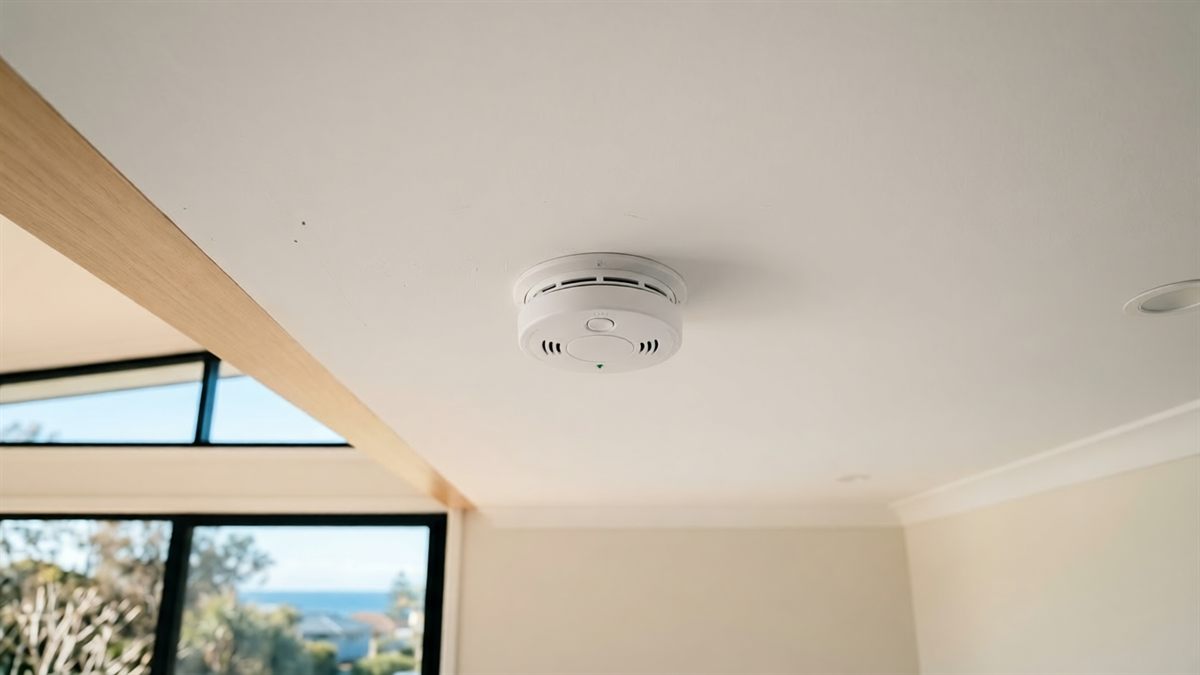
- Alarms must be on the ceiling, at least 300mm from any wall or light fitting, and at least 500mm from corners
- Alarms should not be installed within 400mm of a ceiling fan or air-conditioning vent
For older Northern Beaches homes that have been extended over the years, the bedroom-and-hallway rule sometimes catches owners out. A converted garage, an attic-room loft, or a granny flat all count as separate sleeping zones and need their own alarms.
Northern Beaches: The Local Considerations
Three things come up often when we test alarms across the Beaches.
Salt Air and Coastal Corrosion
Properties within a kilometre of the coast (which is most of Manly, Queenscliff, Curl Curl, Collaroy, Newport, and Avalon) get more corrosion on alarm bases and battery contacts than inland properties. Salt-laden air shortens working life. Replacing slightly before the 10-year mark is sensible for properties closer to the water.
Older Housing Stock with Patchy Renovations
Mid-century homes through Balgowlah, Seaforth, Fairlight, and parts of Frenchs Forest have often been renovated room-by-room over decades. We regularly find rentals where the original section of the home has up-to-date alarms but a 1990s extension has an expired unit, or no alarm at all in the new bedroom.
Strata Apartments and Townhouses
For strata properties through Manly, Dee Why, and Mona Vale, smoke alarm compliance is split between the lot owner (alarms inside the unit) and the owners corporation (common-area alarms, fire safety statements). Landlords who own lots in strata buildings still carry the inside-unit obligation themselves. Confirming with strata management isn't a substitute for testing your own unit's alarms.
What Tenants Can and Can't Do
The 2020 regulation drew clearer lines between landlord and tenant responsibilities. Tenants can:
- Replace removable batteries themselves if they want to (but they're not required to, and the landlord remains legally responsible)
- Notify the landlord of a faulty alarm (must do so within 48 hours of becoming aware)
- Engage a licensed electrician at the landlord's cost if the landlord fails to repair within 48 hours of notification
- Test the alarms themselves (and are encouraged to)
Tenants can't:
- Disconnect or remove an alarm (this is an offence, with penalties)
- Replace the alarm unit itself, only the battery (where removable)
- Refuse the landlord access for testing (with reasonable notice)
- Rely on their own efforts as a defence if a fire occurs and the alarm was non-compliant
Penalties and Real-World Consequences
NSW Fair Trading can issue penalty notices of up to 20 penalty units per breach, which is approximately $2,200 per offence at 2026 rates. Multiple breaches across multiple alarms in one property can compound quickly. A rental with three non-compliant alarms is potentially three separate offences.
The bigger risk is liability if a fire occurs. Insurance claims are routinely reviewed for smoke alarm compliance, and claims have been reduced or denied where alarms were missing, expired, or incorrectly placed. Tenant injury or death in a fire where alarms were non-compliant exposes the landlord to civil claims that go well beyond the original penalty unit fine.
NCAT also handles tenant-initiated disputes. Common orders include compensation for the cost of a tenant having to engage an electrician themselves, rent reductions for the period a property was non-compliant, and lease terminations in serious cases.
What Affects the Cost of Compliance
Smoke alarm compliance costs on the Northern Beaches scale with a few specific factors.
| Service | What drives the cost |
|---|---|
| Annual smoke alarm test | Number of alarms in the property. Most 3-bed homes have 3 to 4 alarms. |
| Test plus written compliance certificate | Adds a small amount of time for the documentation. |
| Replacement of one alarm | 10-year lithium photoelectric, supplied and installed. Cost is the unit plus the labour. |
| Hardwired alarm install | Running new wiring per unit costs more than a swap. Older homes often need this. |
| Full property re-fit | All alarms replaced with new 10-year units. Most efficient option when the existing fleet is ageing. |
| After-hours emergency replacement | Premium applies for the 48-hour-window emergency response. |
Bundling the annual test with any other electrical work (powerpoint, light replacement, switchboard service) usually saves a second callout. Connery Electrical quotes upfront after a free chat about the property, so you know the number before booking.
The Annual Compliance Routine
The simplest way to stay compliant as a Northern Beaches landlord is to book an annual visit at lease anniversary or financial-year end. A licensed electrician arrives, tests every alarm, replaces batteries where required, identifies any unit that's nearing its 10-year limit, and hands over a written compliance certificate. The whole job takes 30 to 60 minutes for a typical 3-bedroom rental.
Landlord Annual Smoke Alarm Checklist
- Test every alarm at lease start or annually
- Document the test (date, address, alarms tested, electrician name and licence)
- Replace removable batteries during the same visit
- Check manufacture date on every alarm; replace any over 10 years old
- Confirm placement matches AS 3786 (every bedroom, hallway, every storey)
- Issue tenant a copy of the compliance certificate
- Keep a copy for your records (NCAT/insurance evidence)
- Respond to any tenant fault report within 48 hours
How Connery Electrical Helps Landlords
We do annual smoke alarm testing and compliance certification across Manly, Dee Why, Brookvale, Mona Vale, Frenchs Forest, Narrabeen, Newport, Avalon, Collaroy, and the rest of the Beaches. Most jobs are a single 30 to 60 minute visit, and you walk away with a written compliance record signed by a licensed NSW electrician (Lic 473086C).
For landlords with multiple rentals, we run batched testing days where we visit several properties in one trip and bill at a reduced per-property rate. Useful for property managers and accidental landlords with two or three places. Worth noting we also handle the wider electrical safety inspection if you want a full check on the whole property at the same time, and the residential electrician services for any other landlord-specific work.
If you've had an alarm fault report from a tenant and you're inside the 48-hour window, give us a bell on 0421 755 198. We can usually attend same-day across the Beaches during business hours.
One more thing. If you're buying a new investment property, request the most recent smoke alarm compliance certificate before settlement. If the seller can't produce one, factor a fresh install into your purchase costs. Saves a scramble in the first weeks of your first tenancy.