Quick answer
Yes, you can charge an EV from a standard 10-amp power point using the portable cable that comes with the car. But it is slow, adding only around 10 to 15km of range per hour, and it puts sustained load on a circuit that was never designed for hours of continuous current. In older Northern Beaches homes that is a genuine overheating risk. Fine for the occasional top-up, not ideal for daily driving. A dedicated wall charger is faster and far safer.
Want a proper charger installed?
Free on-site assessment, then a fixed price before we start.
It's the first thing nearly every new EV owner tries. The car comes with a cable that plugs into a normal wall socket, you plug it in overnight, and in the morning there's more range than yesterday. So why would anyone pay to install a proper charger? The honest answer comes down to two things: speed and safety. Here's what's actually going on when you charge from a power point, and when it's time to do it properly.
How Power Point Charging Actually Works
Most electric cars come with a portable charging cable, sometimes called a "granny charger" or "trickle charger". It plugs into a standard 10-amp Australian power point, the same socket your kettle uses. It's designed as a backup, a get-you-home option, not as your main way of charging.
A standard power point delivers around 2 to 2.4kW. That translates to roughly 10 to 15km of driving range for every hour the car is plugged in. Leave it charging for 10 hours overnight and you'll add somewhere around 100 to 150km. For a lot of people that's enough. For plenty of others, it isn't.
| Charging method | Power | Range added per hour |
|---|---|---|
| Normal power point (10A) | ~2.4kW | ~10 to 15km |
| Home wall charger (7kW single-phase) | 7kW | ~40km |
| Three-phase wall charger (11kW+) | 11kW+ | ~60km+ |
The difference is roughly three to four times faster on a proper home charger. For most full electric cars, a 7kW wall charger means you plug in when you get home and wake up to a full battery, every single day. A power point can't reliably do that for a daily driver with a bigger battery.
The Part Most People Don't Think About: Safety
Speed is the obvious downside. The one that matters more, and gets talked about less, is safety.
Your kettle, your toaster, your hairdryer all draw a decent amount of current, but only for a few minutes at a time. Charging an EV draws around 10 amps continuously for many hours, night after night. That's a completely different kind of demand, and a lot of household wiring and power points were never designed for it.
The real risk: Sustained high current generates heat. On a worn power point, a loose connection, or older cabling behind the wall, that heat builds up over hours of charging. In the worst cases it melts the plug, scorches the socket, or damages the wiring inside the wall. It's one of the most common EV-related call-outs we get.
This matters more on the Northern Beaches than in a lot of places. A big share of homes around here were built between the 1960s and 1990s, and plenty still have their original wiring and switchboards. Add decades of salt air on top, and you've got circuits that are already working hard before you ask them to charge a car every night. If you're plugging into an old power point in an older home, the risk is real.
When a Power Point Is Genuinely Fine
To be fair, power point charging isn't always a problem. It's perfectly sensible in a few situations:
- Plug-in hybrids (PHEVs). Small batteries that charge fully overnight even at the slow rate.
- Low-kilometre drivers. If you only do 30 or 40km a day, a power point easily keeps up.
- Occasional or backup charging. Topping up at a holiday house, or as a fallback when your main charger isn't available.
- Modern wiring in good condition. A newer home with a recently checked power point on a healthy circuit handles light charging without drama.
The key is the word "light". The moment power point charging becomes your daily, every-night routine on an older home, the maths on speed and the risk on safety both start working against you.
Why a Dedicated Wall Charger Is the Better Move
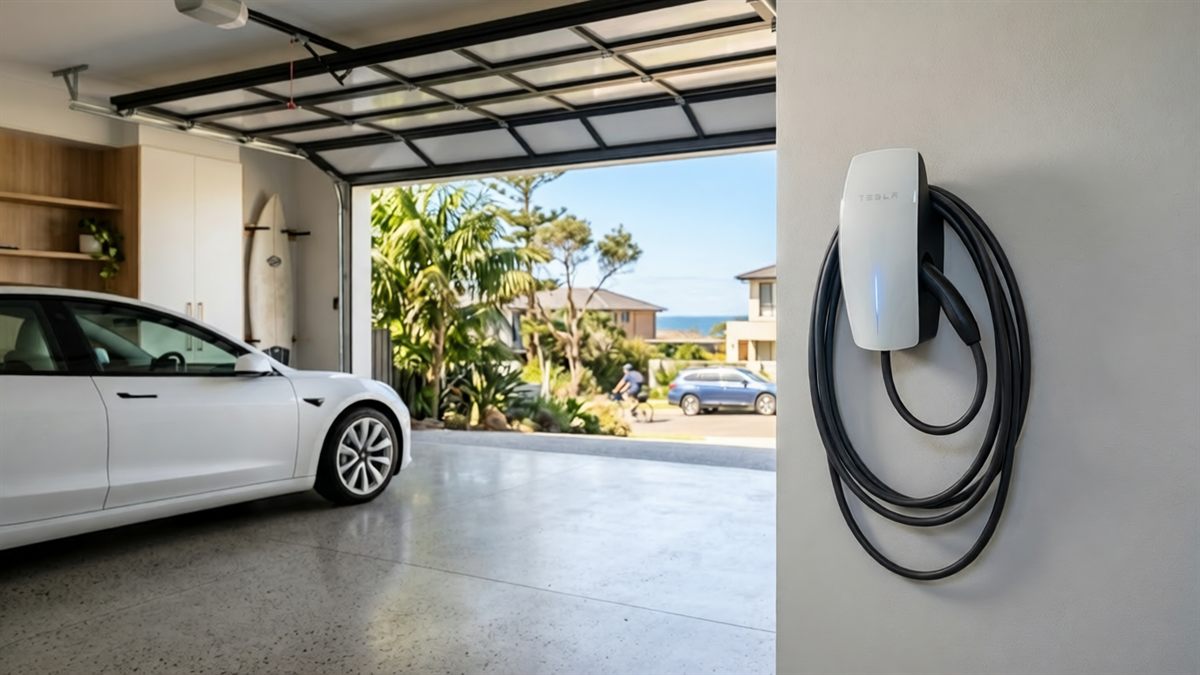
A proper home EV charger isn't just a faster socket. It's a purpose-built setup that solves both problems at once:
- It's on its own dedicated circuit. A wall charger runs on a dedicated 32-amp circuit with its own breaker, completely separate from the rest of the house. No sharing load with the fridge, the aircon, or the power points.
- It's built for continuous load. Everything from the cable to the breaker is rated for hours of high current, so there's no overheating risk like there is with a household socket.
- It's three to four times faster. Around 40km of range per hour instead of 10 to 15, so the car is full every morning.
- It's smarter. Many chargers let you schedule charging for off-peak times, and solar-diverter models like the Zappi charge your car from excess solar during the day.
- It's protected and compliant. Installed by a licensed electrician with the right safety switch protection and a Certificate of Compliance, as required in NSW.
If your switchboard is older, the electrician will check it has the capacity to add a dedicated EV circuit. Some older Northern Beaches boards need a switchboard upgrade first, which is worth knowing before you commit. For the full picture on what a charger install involves and what changes the price, see our guide on EV charger installation cost on the Northern Beaches.
The Bottom Line
Can you charge an EV from a normal power point? Yes. Should you rely on it as your daily charger, especially in an older home? Probably not. It's slow, and the sustained load on a socket that wasn't built for it is a genuine safety risk we see go wrong often enough to take seriously.
For the occasional top-up it's fine. For everyday charging, a dedicated wall charger is faster, safer, and far less hassle. If you've just gone electric and you're not sure whether your home can handle a proper charger, the easiest first step is a free on-site assessment.
Connery Electrical installs EV chargers across the Northern Beaches every week, and we'll tell you honestly what your home needs. See our EV charger installation service or call 0421 755 198 for a free, no-obligation quote.