Quick answer
Yes. If you plug in during the day, your solar can charge your EV. To run purely off your spare solar with no grid power, you need a smart charger with solar diversion, like a Zappi. For most Northern Beaches homes with 6.6kW or more of solar, charging the car off the sun is one of the cheapest ways to run a car in the country, often close to free.
With power prices where they are and feed-in tariffs a fraction of what they used to be, more Northern Beaches drivers are asking the same thing: can I just charge my EV off my solar panels? The short answer is yes, and it's one of the smartest moves you can make with an electric car. Here's exactly how it works, what you need, and what happens when the sun goes down.
How Solar EV Charging Actually Works
Your solar panels make power during the day. Right now, any of that power your home isn't using gets exported to the grid, and you're paid a small feed-in tariff for it, usually only a few cents per kilowatt-hour. That number has dropped a lot over the years, so exporting your spare solar is worth less and less.
Charging your EV flips that on its head. Instead of selling spare solar for a few cents, you pour it straight into your car and avoid buying petrol or grid electricity worth far more. The power you would have exported for almost nothing becomes free kilometres. That's the whole appeal: you're using energy you've already paid for the panels to make.
The simple version: every kilowatt-hour of solar you send to your car is a kilowatt-hour you didn't buy from the grid or a servo. On the Northern Beaches, that's the difference between charging for a few cents and paying full retail power prices at night.
The Three Ways to Charge an EV With Solar
There's more than one way to do this, and they suit different homes and budgets. Here's the honest rundown.
1. Plug In During the Day
The simplest option. If you're home during the day, or the car sits in the driveway while you work from home, just plug in when the sun is up. Your home uses solar first, and the car soaks up whatever the panels are producing, topping up any shortfall from the grid. No special gear needed, any quality home charger does this. The downside: you're not guaranteed to be charging on solar only, so some grid power can sneak in on cloudy patches.
2. A Smart Charger With Solar Diversion
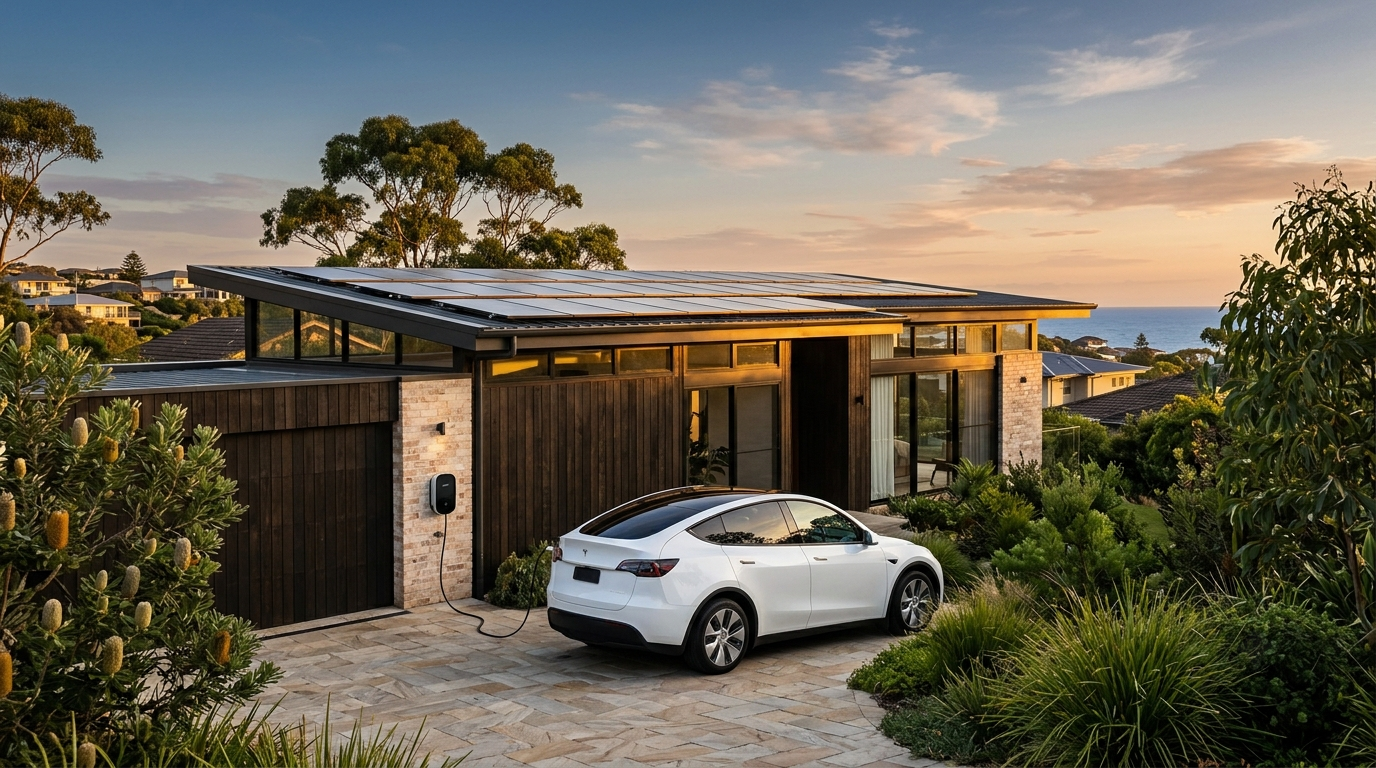
This is the proper solar setup. A smart charger like the Zappi watches exactly what your panels are exporting and diverts only that spare solar into the car. Set it to solar-only mode and it will never pull a watt from the grid, it charges faster when the sun's out and slows down when a cloud rolls over. It's the closest thing to charging your car for free, and it's the option we fit most for solar households on the Beaches. We cover the smart-versus-basic decision in our guide to choosing the right EV charger for your car.
3. Add a Home Battery
If you're out all day and the car isn't home when the sun is, a home battery bridges the gap. It stores your daytime solar and discharges it to charge the car overnight. It's the most expensive path and the maths only stacks up for some homes, but it means genuine solar charging even when you plug in at 7pm.
How Much Solar Do You Need?
A common worry is that a small rooftop system won't cut it. In reality, most modern systems on the Northern Beaches are more than up to the job.
| Solar system size | What it can do for EV charging |
|---|---|
| Under 5kW | Helps, but usually charges the car slowly or tops up from the grid on cloudy days |
| 6.6kW (the common size) | Runs a 7kW charger well in good midday sun; strong solar charging for most homes |
| 10kW and up | Charges the car at full speed on solar while still powering the house |
A 7kW home charger needs roughly 7kW of production to run flat out on the sun alone. A 6.6kW system gets there in strong midday light, and even when it can't, a smart charger simply slows the car to match whatever the panels are making. You don't need a giant system to make this worthwhile, you just match the charger to what you've got. If your system is on the smaller side, a slower solar charge overnight-in-daytime still saves you real money.
What About Cloudy Days and Night?
This is where people get stuck, so let's be straight about it. Solar only makes power in daylight, so pure solar charging means charging during the day. For the times that doesn't work, you've got two easy fallbacks:
- Off-peak tariff at night. Set a smart charger to run during the cheap overnight electricity window. It's not solar, but it's the next-cheapest power you can buy.
- A home battery. Stores the day's solar for an overnight charge, if the numbers suit your home.
For a lot of Beaches households, the winning combo is simple: charge off solar during the day when you can, and top up on a cheap overnight tariff when you can't. You rarely need to pay full-price daytime grid rates for the car at all.
The Part That Really Decides Your Install
Here's what we tell every solar customer: the panels and the charger are the easy bit. The real question is whether your switchboard and existing solar wiring can safely take a dedicated EV circuit and a smart charger that talks to your solar inverter. Plenty of Northern Beaches homes have older boards, or a solar setup that needs the right metering for diversion to work. Those need sorting first, and sometimes that means a switchboard upgrade before anything goes in.
That's why we always start with a free on-site assessment. We look at your solar size and inverter, your switchboard, and where the car parks, then recommend the right charger and setup to get the most free kilometres out of your panels. No overselling you gear your system can't use. See what's involved on our EV charger installation page, or if you're weighing up a wall charger versus the powerpoint, start with charging an EV from a normal power point.