Quick answer
The Tesla Wall Connector is a 7kW home charger (up to 22kW on three-phase) that mounts to your wall and hardwires into a dedicated circuit. It suits the Model 3, Model Y, Model S and Model X, connects to your wifi and the Tesla app, and supports power sharing for a second car. In NSW it must be installed by a licensed electrician with a Certificate of Compliance. Connery Electrical installs them across the Northern Beaches with a free on-site assessment first.
If you've just picked up a Tesla, or you're about to, a home charger is the upgrade that makes living with it easy. You wake up to a full battery every morning and you stop thinking about public chargers. The Tesla Wall Connector is the unit most owners ask us about, so here's the plain-English rundown on what it does, which version to get, and what a proper install actually looks like on a Northern Beaches home.
Quick note on cost: this guide is about the unit and the install itself. For real pricing and what pushes a quote up or down, see our separate guide on EV charger installation cost on the Northern Beaches. The short version: it comes down to your switchboard and the cable run, not the Tesla badge.
What the Tesla Wall Connector Actually Is
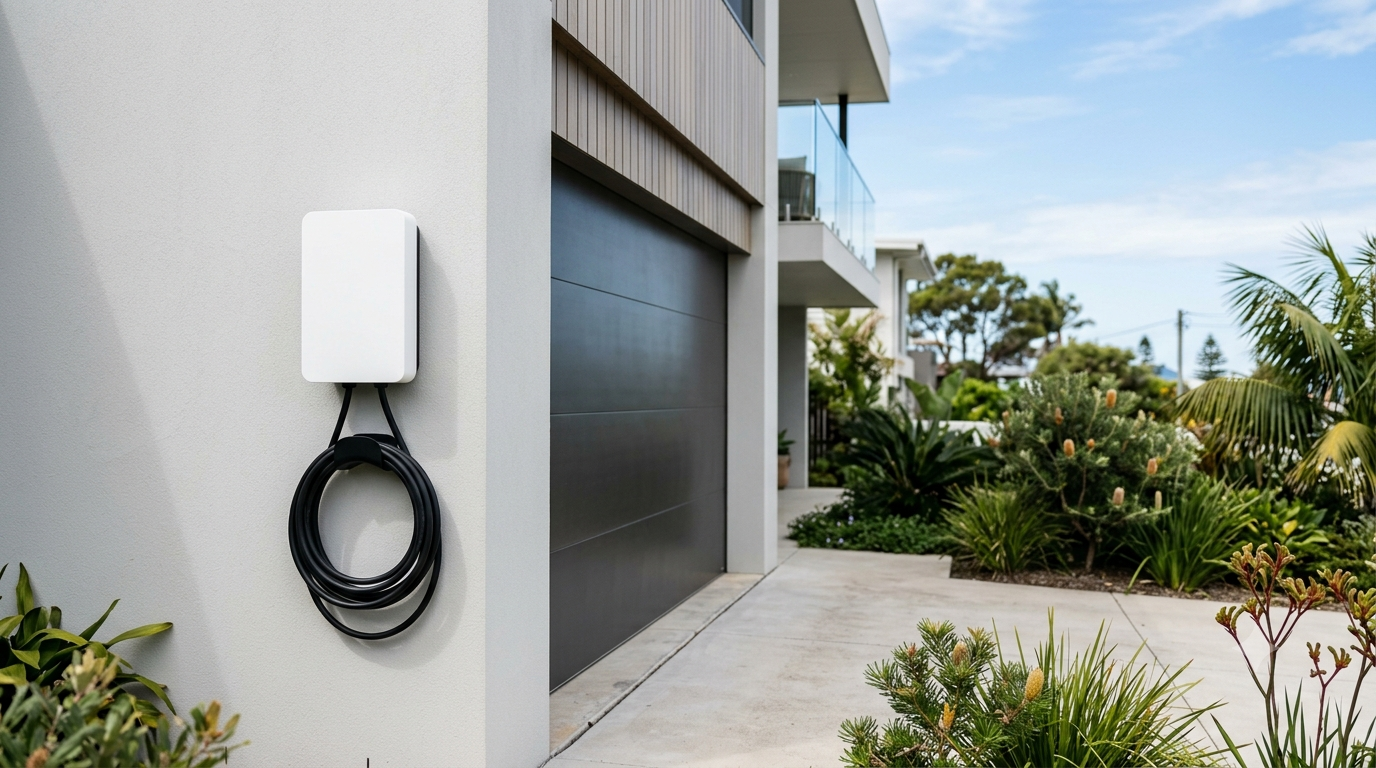
The Tesla Wall Connector (currently the third-generation unit) is a permanently wired home charging station. Unlike the mobile charger that comes in the boot, it hardwires into a dedicated circuit at your switchboard, so it's faster, safer for daily use, and always there on the wall ready to go.
The headline numbers: on single-phase power it delivers up to 7kW, which adds roughly 40km of range for every hour of charging. That means a normal overnight charge easily covers a week of typical Northern Beaches driving. It has a generous cable (around 2.6m) so it reaches the car comfortably, and it connects to your home wifi so you can manage charging, set off-peak schedules, and check on it from the Tesla app.
Wall Connector vs Universal vs Mobile Connector
Tesla sells three different chargers and the names cause a lot of confusion. Here's the difference in plain terms.
| Charger | What it is | Best for |
|---|---|---|
| Wall Connector | Hardwired 7kW (up to 22kW three-phase) home unit with the Tesla plug | Tesla owners who want the fastest, tidiest permanent home charger |
| Universal Wall Connector | Same unit with a built-in Type 2 socket, so it charges any EV | Households that may switch to a non-Tesla EV later, or have two different cars |
| Mobile Connector | The portable charger that comes with the car, plugs into a powerpoint | A slow backup, or occasional charging. Not ideal as your only daily charger |
For most Tesla households, the standard Wall Connector is the right call. If there's any chance you'll add or switch to a non-Tesla EV down the track, the Universal Wall Connector is worth the small extra so one unit covers every car. We'll talk you through which makes sense for your situation at the assessment.
Does It Suit Your Tesla?
Yes, across the board. The Wall Connector works with the Model 3, Model Y, Model S and Model X. Every Tesla sold in Australia uses the standard Type 2 connector, the same plug the rest of the EV market uses here, so there are no compatibility headaches. If you're weighing up the Tesla unit against a standard Type 2 charger, we've written a separate guide on which EV charger is right for your car.
Single-Phase or Three-Phase?
The Wall Connector can run anywhere from 7kW on single-phase up to 22kW on three-phase. That sounds like an easy win for three-phase, but it only matters if two things are true: your home actually has three-phase supply, and you genuinely need to charge faster than overnight.
Most homes on the Northern Beaches are single-phase, and for the vast majority of drivers a 7kW single-phase unit is plenty. You plug in when you get home, and it's full by morning. Three-phase is worth it for high-kilometre drivers, multi-EV households, or homes that already have three-phase power for other reasons. We confirm what your home has and what you actually need before you spend money on a faster unit you won't use.
Charging Two Cars: Power Sharing
One of the Wall Connector's best features is power sharing. You can link up to six units on a single circuit, and they automatically divide the available power between whichever cars are plugged in. For a two-Tesla household, that means you can charge both overnight without paying to upgrade your home's electrical supply to run two full-speed chargers at once.
Even if you've only got one EV today, it's worth a quick chat at the assessment about wiring the home so a second unit is easy to add later. A little planning now saves a bigger job down the track.
What the Install Involves
From your side, a straightforward job is one visit. Here's what actually happens:
- Free on-site assessment. We check your switchboard, measure the cable run, confirm the best spot for the unit, and give you a fixed-price quote upfront with no surprises.
- Switchboard check. An EV charger runs on a dedicated 32-amp circuit, so the board needs spare capacity and proper RCD protection. Older boards sometimes need an upgrade first, which we'll flag before any work starts.
- Cable run and dedicated circuit. We run the cable from the switchboard to the charger location and add a dedicated breaker for it. Short runs near the meter box are simplest; longer runs to a back garage take more cable and time.
- Mount and hardwire the unit. The Wall Connector is fixed to the wall and wired in properly, indoors or out.
- Commission and test. We power it up, connect it to your wifi and the Tesla app, set any off-peak schedule you want, test everything, and issue your Certificate of Compliance.
Why It Has to Be a Licensed Electrician
In NSW it's illegal to do your own fixed electrical wiring, and for good reason. An EV charger pulls a high, sustained current for hours at a time, which is exactly the kind of load that finds any weakness in older wiring or an undersized circuit. A licensed install done to AS/NZS 3000 is the difference between a charger that runs safely for years and a genuine fire risk.
There's a paperwork side too. A licensed install comes with a Certificate of Compliance, which is legally required in NSW. An unlicensed or DIY job can void the unit's warranty and create problems with your home insurance if anything ever goes wrong.
Why Northern Beaches Homes Can Differ
A lot of homes around here were built between the 1960s and 1990s and still run their original switchboards. Add the salt air that corrodes external wiring over time, and you get more homes than average that need a switchboard assessment before an EV circuit can safely go in. It's not every home. Newer builds and renovated places in spots like Warriewood, Avalon and Curl Curl often have modern boards with spare capacity. The only way to know is to look, which is exactly what the free assessment is for. If you want the full rundown, see our guide on 7 signs your switchboard needs upgrading.
The Bottom Line
The Tesla Wall Connector is a clean, fast, well-built home charger, and for most Tesla owners on the Northern Beaches it's the easy choice. The install itself is straightforward in a modern home, and the only real variables are your switchboard and the cable run. Get those checked properly, use a licensed sparky, and you'll be waking up to a full battery every morning.
Want a no-obligation quote on your home? Connery Electrical installs Tesla Wall Connectors across the Northern Beaches every week. See our EV charger installation service or call 0421 755 198.